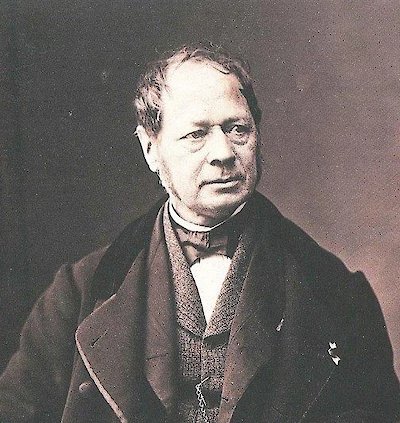
Hippolyte Bayard was a French photographer who independently developed his own photographic process in 1839 — one of the true co-inventors of photography. Despite his achievements, he was persuaded to delay announcing his invention and has been largely overlooked by history.
Early Life
Hippolyte Bayard was born on 20 January 1801 in Breteuil-sur-Noye, Oise, France. He worked as a civil servant at the Ministry of Finance in Paris, pursuing photography as a passionate interest alongside his official duties.
An Independent Invention
In early 1839, working independently and without knowledge of either Niépce or Daguerre's work, Bayard developed a process for creating direct positive paper prints. His method was fundamentally different — while Daguerre's process created images on metal plates and Talbot's on paper negatives, Bayard could produce positive paper prints directly in the camera.
He demonstrated his process to the French Academy of Sciences in June 1839 — before Daguerre's process was officially announced. However, the physicist François Arago, who was championing Daguerre's process, persuaded Bayard to delay his public announcement to avoid diminishing Daguerre's achievement. In return, Bayard received a modest payment of 600 francs.
The First Photography Exhibition
Despite being asked to delay, Bayard organised and held the world's first public exhibition of photographs in Paris in July 1839 — displaying 30 of his photographs. This exhibition preceded the official public announcement of Daguerre's process on 19 August 1839.
Self Portrait as a Drowned Man
In October 1840, bitter at being overlooked, Bayard created one of photography's most remarkable and poignant images: "Self Portrait as a Drowned Man." In this staged photograph he appears as a corpse, accompanied by a note protesting that he had been ignored while Daguerre received fame and fortune. It is considered one of the first examples of staged or conceptual photography.
Legacy
Bayard continued working as a photographer throughout his life, becoming one of the founding members of the Société française de photographie in 1854. He died on 14 May 1887, still largely unrecognised as one of photography's true pioneers. His story serves as a reminder that the invention of photography was not a single achievement but the result of several independent simultaneous discoveries.